Posted by Mark Brousseau
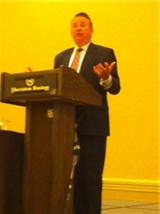
“No one wants to hear about adding more employees,” Lisa Coleman, MHA, RHIA, director, Centralized Scanning, Memorial Hermann Healthcare System (MHHS), told attendees during a session today at FUSION 2010 at the Gaylord Texan Resort & Convention Center near Dallas.
That created a challenge when MHHS decided several years ago to centralize its scanning operation – which had been spread across MHHS’ 11 hospitals in the Houston, Texas, area – and add inpatient records to the documents it was scanning – all while adhering to a strict 24-hour turnaround time for scanning patient records. By centralizing its scanning operations, MHHS hoped to achieve:
• Centralized management
• Standardized processes and cross coverage
• Reduced manual intervention
• Decreased operating costs
• Improved customer service
• Increased productivity
• Complete Electronic Medical Record (EMR) processes (add inpatient records)
• Adherence with MHHS’ 24 hour turnaround deadline
• Secure record access (role-based, audit trail)
In 2002, MHHS implemented a Sovera health information management (HIM) system to ensure compliance with HIPAA regulations and establish a centralized scanning infrastructure. At this time, scanning was decentralized across MHHS’ hospital network. In 2006, MHHS made the decision to add inpatient records to its scanning program. Scanning inpatient records would have a positive impact on the hospital’s migration to EMRs, Coleman said. But it also posed a problem in terms of significantly higher document volumes. “To meet our deadlines using our existing scanning infrastructure would have required at least three additional mid-volume scanners and 10 full-time equivalents,” Coleman told attendees.
As a solution, CGI Group presented the ImageTrac scanners from Birmingham, AL-based ibml. CGI Group arranged a site visit of a nearby ibml user – EDCO – to see firsthand the hardware’s capabilities and observe the processes the user put in place to streamline the document scanning workflow. “We were surprised at how different the ibml scanners were from our own; it was more like an assembly line,” she said.
MHHS decided to purchase two ibml ImageTrac scanners. The scanners were integrated with MHHS’ Datacap Taskmaster software to take out some of the manual intervention. “The more manual tasks you have, the more prone you are to have errors,” Coleman emphasized to attendees.
During implementation, CGI Group and ibml provided MHHS employees with a two-week course of hands-on training. Throughout implementation and training, MHHS continued to operate its legacy scanning infrastructure. “We wanted to run the systems in parallel before making the switch.”
With the new workflow, records are picked up and reconciled at the facility where they originated. Once reconciled, records are transported to the hospital’s centralized scanning facility where employees check them in and perform a quality check to ensure all of the records are accounted for. Batches then are delivered to a scanning station where a scanner operator images the document batches. At this time, key data is extracted from a barcode, documents are converted to digital images, and the images are sent to the hospital’s Datacap Taskmaster software solution.
By centralizing its scanning operations, Coleman said MHHS has achieved several benefits:
• Much faster document throughput with the ImageTrac scanners
• No need to hire additional staff
• Shifted staff from scanning to capture functions
• Records are scanned within 8 hours of receipt
• Physicians and medical staff now have instant access to records
The bottom line: MHHS achieved full payback in about 18 months.